
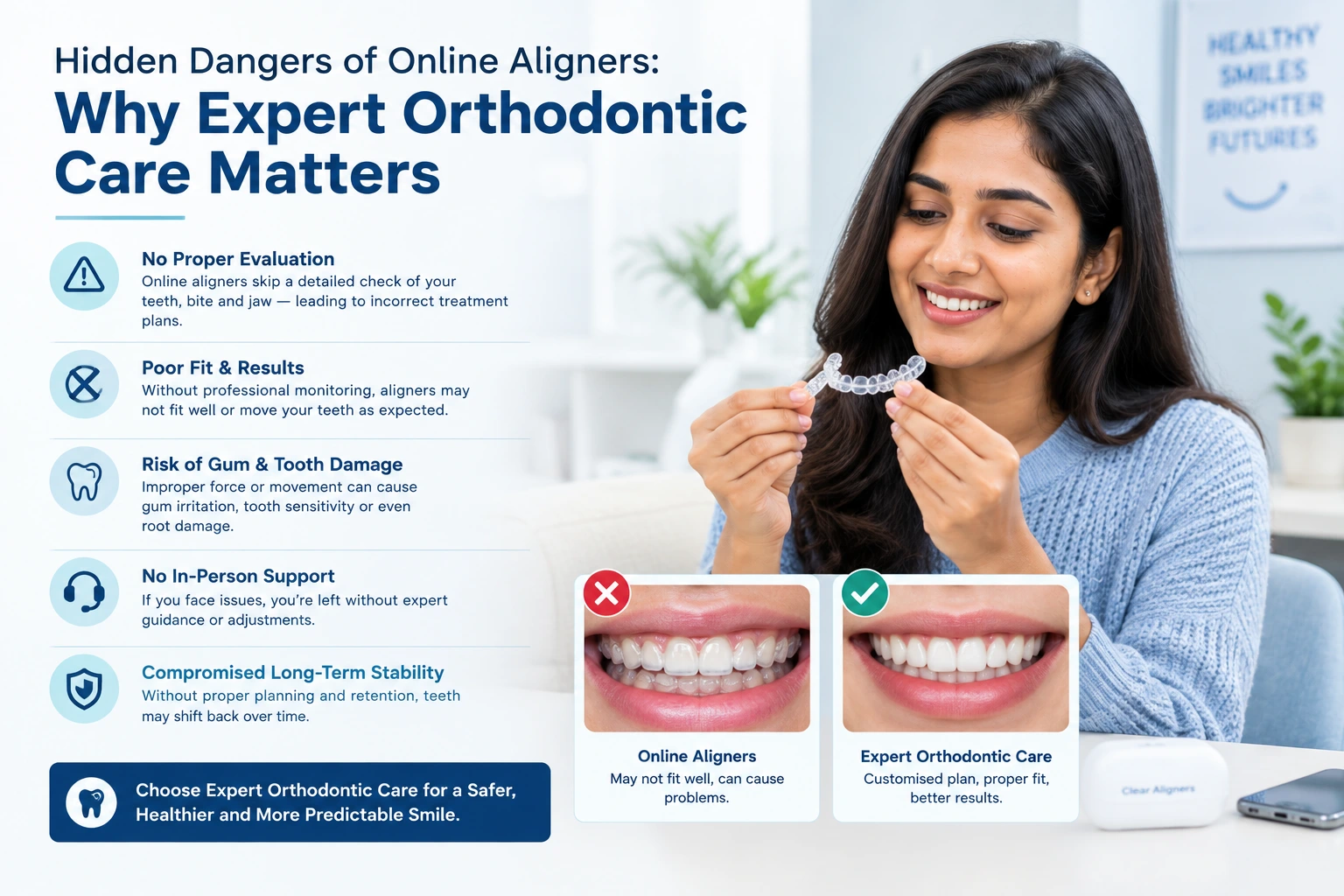
Clear aligners have become a popular alternative to traditional braces because they are discreet, removable, and convenient. With online platforms offering aligners that can be ordered from home, orthodontic treatment may appear easier than ever. However, convenience should not replace professional diagnosis and supervision.
The success of aligner treatment depends on much more than wearing a series of transparent trays. An orthodontist needs to evaluate your teeth, gums, bite, jaw relationship, and overall oral health before deciding whether aligners are appropriate.
If you are considering clear aligners, understanding the potential risks of unsupervised or poorly supervised treatment can help you make a safer and more informed decision.
Search Intent Analysis
People searching for information about the hidden dangers of online aligners generally want to understand:
- Whether online aligners are safe
- What can go wrong without an in-person examination
- Whether aligners can damage teeth or gums
- Why orthodontic supervision matters
- How to choose a qualified orthodontic professional
- Whether clear aligners are suitable for their specific dental problem
This article addresses these concerns while explaining why professional assessment should be an important part of orthodontic treatment.
What Are Online Aligners?
Online aligner services typically allow patients to begin treatment with limited or no traditional in-person orthodontic appointments. Depending on the provider, a patient may submit photographs, complete an at-home impression or scan, and receive a series of aligners.
While remote monitoring can be useful in selected situations, orthodontic treatment is not simply about moving visible teeth. Tooth movement affects the roots, gums, supporting bone, and bite. These factors cannot always be accurately assessed from photographs or impressions alone.
Professional evaluation is therefore important before starting any treatment designed to permanently change tooth position.
Hidden Dangers of Online Aligner Treatment
1. Incomplete Diagnosis
One of the biggest concerns with unsupervised aligner treatment is inadequate diagnosis.
An orthodontist does not evaluate only whether teeth appear crooked. They also assess spacing, crowding, bite relationships, jaw position, tooth roots, gum health, and other factors that can influence treatment.
In some cases, dental X-rays or additional diagnostic records may be necessary. Without an appropriate examination, an important underlying problem could remain undetected.
2. Moving Teeth Without Addressing Oral Health Problems
Existing cavities, gum disease, infections, damaged teeth, or other oral health concerns may need attention before orthodontic treatment begins.
Moving teeth while an untreated dental problem is present may complicate the situation. A professional examination helps identify problems that should be managed before aligner treatment starts.
This is one reason patients should not choose an orthodontic plan based solely on photographs or an online questionnaire.
3. Incorrect Tooth Movement
Aligners apply controlled forces to gradually move teeth. However, not every tooth movement is equally predictable.
Certain movements may require attachments, additional appliances, refinements, or closer clinical monitoring. If the treatment plan does not adequately account for the patient’s anatomy and bite, the final result may not match expectations.
Inappropriate tooth movement can potentially contribute to bite problems, discomfort, gum issues, or an unsatisfactory aesthetic result.
4. Bite Problems
Straight-looking teeth do not necessarily mean a healthy bite.
Orthodontic treatment should consider how the upper and lower teeth come together when a person bites and chews. Poorly planned tooth movement can sometimes alter the bite in undesirable ways.
An orthodontist can monitor these changes throughout treatment and modify the treatment plan when necessary.
5. Gum Recession and Supporting-Tissue Concerns
Teeth are supported by gums and bone. Moving teeth beyond the limits of their supporting structures may increase the risk of periodontal complications in susceptible individuals.
A clinical examination helps the orthodontist understand the condition of the gums and supporting tissues before treatment. This is particularly important for patients who already have thin gum tissue or periodontal concerns.
6. Lack of Regular Clinical Monitoring
Orthodontic treatment is not always completely predictable. Teeth may respond differently from what was initially expected.
Regular professional reviews allow an orthodontist to check progress and determine whether the planned tooth movements are occurring correctly. If something is not progressing as expected, adjustments can be made.
Without adequate monitoring, a problem may continue unnoticed for longer.
7. Retention Problems After Treatment
Finishing the final aligner does not mean orthodontic treatment is permanently complete.
Teeth can naturally shift after orthodontic treatment. Retainers are generally needed to help maintain the achieved position.
A professional can recommend an appropriate retention strategy based on the patient’s treatment and individual needs.
Online Aligners vs. Orthodontist-Supervised Treatment
The main difference is not simply the type of aligner being used. It is the level of diagnosis, planning, supervision, and clinical accountability involved.
A professionally supervised treatment plan may include:
- Comprehensive dental and orthodontic examination
- Evaluation of the bite and jaw relationship
- Dental photographs and scans or impressions
- X-rays when clinically indicated
- Assessment of gum and tooth health
- Customized treatment planning
- Regular progress monitoring
- Treatment refinements when required
- Retention planning after active treatment
Technology can make orthodontic treatment more convenient, but it should support professional care rather than replace it.
Are Clear Aligners Suitable for Everyone?
No. Clear aligners can be effective for many orthodontic concerns, including selected cases of crowding, spacing, and certain bite problems. However, suitability depends on the individual’s dental condition and treatment goals.
Some complex cases may require traditional braces, attachments, elastics, or other orthodontic approaches.
For patients specifically considering Invisalign Treatment in Kothrud, a professional consultation can help determine whether this type of clear-aligner treatment is appropriate for their needs.
Why Expert Orthodontic Care Matters
Choosing orthodontic treatment is a long-term decision. The goal should not simply be to make teeth look straighter in photographs. Treatment should aim for a healthy, functional, stable, and aesthetically pleasing result.
A qualified dental professional can identify potential risks, explain realistic outcomes, and monitor your progress throughout treatment.
When searching for a Dental Clinic in Kothrud, consider factors such as professional qualifications, clinical experience, diagnostic facilities, treatment planning, follow-up care, and the ability to manage complications if they occur.
Patients looking for the Best Orthodontic Treatments in Kothrud should also compare treatment options rather than selecting a service based only on price or convenience.
What Should You Ask Before Starting Aligner Treatment?
Before beginning treatment, ask:
- Who will examine and supervise my treatment?
- Will my bite be evaluated?
- Are X-rays required in my case?
- Are my teeth and gums healthy enough for orthodontic treatment?
- What happens if my teeth do not move as predicted?
- Will refinements be available if required?
- What type of retainer will I need after treatment?
- What happens if I experience pain or another dental problem?
Clear answers to these questions can help you understand whether the treatment plan is appropriately supervised.
Choosing the Right Dental Professional
The right provider should prioritize diagnosis and long-term oral health rather than simply promising a quick cosmetic transformation.
Patients searching for the Best dentist in Kothrud should look beyond online ratings and consider clinical experience, communication, treatment planning, and follow-up support.
Similarly, someone searching for Best Dentists Near Me in Kothrud, Pune should make sure the chosen professional can provide appropriate in-person evaluation and ongoing care when needed.
Why Choose Tooth and Co Dental Clinic?
At Tooth and Co Dental Clinic, orthodontic care is approached with attention to individual dental needs rather than using a one-size-fits-all approach.
Dr. Saloni Bavalekar can evaluate your teeth, bite, oral health, and treatment goals before recommending an appropriate orthodontic option.
If you are comparing options and looking for the Best Dental Clinic in Kothrud, a professional consultation can help you understand which treatment approach is suitable for your smile.
Frequently Asked Questions
Q1. Are online aligners completely unsafe?
Not necessarily. Some remote or hybrid orthodontic services may be appropriate for carefully selected cases when qualified professionals are involved. The concern is inadequate diagnosis, supervision, or follow-up rather than the concept of clear aligners itself.
Q2. Can online aligners damage teeth?
Poorly planned or inadequately monitored tooth movement may contribute to problems involving the bite, gums, or tooth position. A professional assessment helps reduce these risks.
Q3. Do clear aligners require an orthodontist?
Clear-aligner treatment should involve appropriate professional evaluation and supervision. The level of in-person care required depends on the individual case.
Q4. Are clear aligners better than braces?
Neither option is universally better. The appropriate treatment depends on the patient’s orthodontic problem, treatment goals, oral health, and clinical requirements.
Q5. What should I do before ordering online aligners?
Have a comprehensive dental and orthodontic examination first. Discuss your bite, gum health, tooth movement requirements, expected results, treatment duration, and retention plan with a qualified professional.
Conclusion
Online aligners may offer convenience, but orthodontic treatment involves biological changes that deserve professional attention. Inadequate diagnosis, incorrect tooth movement, bite changes, gum complications, and insufficient monitoring are potential concerns when treatment is not appropriately supervised.
The safest approach is to understand your dental condition first and then choose a treatment plan based on professional evaluation rather than convenience alone.
If you are considering clear aligners, consult Dr. Saloni Bavalekar at Tooth and Co Dental Clinic for a personalized assessment. A professional consultation can help you understand your orthodontic needs, available treatment options, expected results, and the steps required to achieve a healthier and more confident smile.
Thinking about clear aligners? Don’t start with the trays—start with the diagnosis.
Book a consultation with Dr. Saloni Bavalekar at Tooth and Co Dental Clinic to discuss your smile concerns and determine the most suitable orthodontic treatment for you.